Where to Find Used Food Trailers for Sale: The Complete Buyer’s Guide

Is the founder of ‘Sabor sobre Ruedas’, a successful food trailer specializing in Latin American fusion cuisine. With a passion for culinary innovation,
You’re thinking about launching a food business but balking at the $250K brick-and-mortar investment. Here’s the uncomfortable truth that most guides won’t tell you: most used food trailers available online are garbage. Undisclosed water damage, rusted frames, fraudulent listings, electrical nightmares—they’re everywhere. The platforms are flooded with them.
But here’s what separates successful food entrepreneurs from those burning cash: knowing exactly where to search, what red flags disqualify a trailer in 10 seconds, and how to negotiate prices down by 20-30% using inspection findings as leverage.
This isn’t just another roundup of websites. This is your insider playbook the exact methodology that separates savvy buyers who land $15K trailers for $11K from novices who overpay for equipment disasters.
The Best Platforms to Buy Used Food Trailers for Sale
The difference between finding a gem and a lemon comes down to one thing: where you’re searching. Not all platforms are created equal.
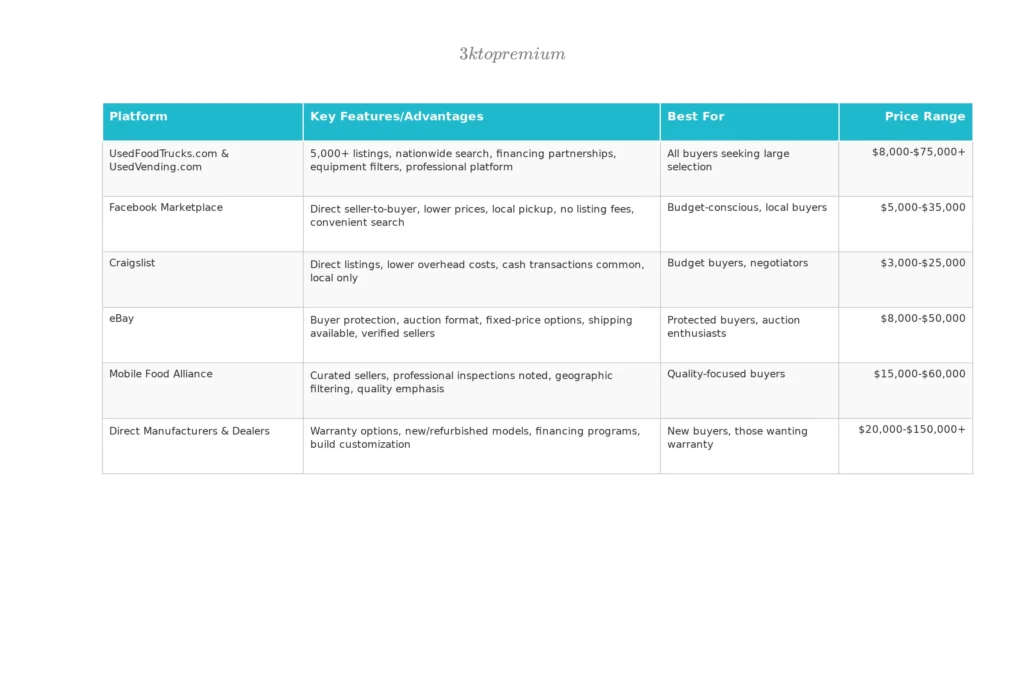
UsedFoodTrucks.com & UsedVending.com The Powerhouse Platform (Largest Inventory, Nationwide)
This is where serious buyers start. UsedFoodTrucks.com and UsedVending.com now operate as a unified marketplace with over 5,700+ active listings across all categories.
Why this dominates:
The interface lets you filter by price, location, equipment type, size, and condition in ways other platforms can’t match. Want only fully equipped 20-foot concession trailers under $30K within 500 miles of your zip code? Done. You’ll get 47 results instead of scrolling through 10,000 irrelevant listings.
The platform also partners with equipment financing companies, meaning you can explore loan pre-approval before committing to a specific trailer. Vendor financing terms typically run 24-60 months at 8-15% APR, with some deals offering low or no money down.
The catch: Prices here run 10-20% higher than Craigslist or Facebook because dealers know this attracts serious, pre-qualified buyers. The trade-off? You skip the scammers peddling phantom inventory and actually see real trailers.
Facebook Marketplace & Craigslist Direct Seller Options (The Budget Play)
When you’re broke or disciplined about negotiation, these become your hunting grounds.
Facebook Marketplace and Craigslist eliminate the dealer middleman entirely. Sellers list their own equipment directly, which means they’re often desperate to move inventory before winter, downsizing operations, or upgrading. This desperation = leverage for you.
Price advantage: Expect 15-30% lower prices versus UsedVending.com. A trailer listed at $28K on UsedVending.com might be $19K on Facebook because the owner avoids merchant fees and wants a quick cash sale.
The dirty truth: You’re handling all the vetting yourself. The seller who posts a pristine-looking photo at $8,995 might be using images from a different trailer entirely (this is rampant). You must inspect in person. You must verify the VIN matches the title. You must test every electrical outlet, peek into the propane compartment, and check for soft spots on the floor.
Local pickup saves $500-$2,000 in shipping costs, making Facebook and Craigslist formidable for buyers within towing distance of their location.
eBay The Auction Wild Card (Buyer Protection + Competitive Bidding)
eBay’s Food Trucks & Concession Trailers category operates on two models: auction format and fixed-price listings
The psychological advantage: auction listings create urgency and can drive competitive bids, sometimes revealing true market value. Fixed-price listings offer certainty you know exactly what you’re paying.
Built-in protection: eBay’s buyer protection program is dramatically stronger than Facebook or Craigslist. If the trailer arrives damaged, the title is fraudulent, or the condition doesn’t match the listing, you have recourse that actually works. This matters when you’re shipping interstate.
International shipping caveat: While eBay enables global purchases, importing food trailers from China or Europe introduces customs delays, quality inconsistency, and limited recourse if the equipment doesn’t meet US health and safety standards. Skip this unless the price gap is absolutely ridiculous and you have access to professional inspection overseas.
Mobile Food Alliance Curated Quality (Professional Filter)
Mobile Food Alliance operates as a marketplace with actual curation. They don’t accept every listing sellers go through verification, and professional inspections are noted in descriptions when available.
This middle ground between raw Craigslist chaos and the polished UsedVending.com experience means you’ll see fewer scams but also fewer listings overall. Prices track slightly above Facebook but below major platforms due to lower traffic.
Geographic filtering tools make finding trailers in your region painless. If you’re in Denver, you’re not wading through 1,000 California listings to find three in Colorado.
Direct Manufacturers & Dealers New & Refurbished Options
Want a warranty? Want customization? Desperate enough to buy new?
Manufacturers and established dealers like Concession Nation and Golden State Trailers offer three distinct advantages: certified refurbished inventory (trailers that failed cosmetic inspection but are mechanically solid), manufacturer warranties covering early failures, and rent-to-own programs that let you test-drive ownership before committing.
The premium: Expect to pay $35K-$75K for what you’d find used for $18K-$40K on Facebook. The trade-off? You have actual recourse if the electrical system catches fire in month six. You get professional installation of custom equipment. You get training on specialized equipment (like pizza ovens).
Rent-to-own programs run 3-5 years with equity buildup. Roaming Hunger, for example, structures lease-to-own with marketing support included website design, social media launch, catering opportunities. This bundled value can exceed $90,000 over the lease term.
Used Food Trailers by Price Range Where to Search by Budget
Your budget isn’t just a number it’s a filter that determines where you’ll actually find options. Search the wrong platform for your budget and you’re wasting weeks.
Under $5,000 The Fixer-Upper Hunt
Primary platforms: Craigslist, Facebook Marketplace, local farm equipment auctions, estate sales.
What you’re actually getting: 1990s-era concession trailers, cargo trailers converted to food service (sketchy health code compliance), equipment-only deals where the trailer frame is afterthought.
The reality check: At this price point, the word “used” becomes an understatement. You’re buying damaged goods that require significant repair or parts replacement. Electrical systems often need rewiring. Plumbing leaks are standard. Flooring will have soft spots indicating water damage.
When to jump on this: You’re mechanically inclined, have professional inspector contacts, and view this as a 6-month restoration project rather than a business launch. You have capital to sink another $5K-$8K into frame repairs, electrical upgrades, and propane system recertification.
When to walk: The seller refuses on-site inspection, the VIN doesn’t match the title, or you detect musty odors indicating mold in hidden cavities.
$5,000 to $15,000 The Sweet Spot for Value Buyers
Best platforms: UsedFoodTrucks.com, Facebook Marketplace, eBay (fixed-price listings).
What this gets you: 2010-2018 model year concession trailers, 16-20 feet long, with partial equipment (some appliances work, some need replacement), visible cosmetic issues but functional structure.
Quality ceiling: These trailers work. The propane system is certified. Electrical testing shows proper grounding. Plumbing functions for basic operations. You’re not rebuilding you’re optimizing.
Financing reality: This is where equipment financing becomes accessible. Banks and credit unions happily fund $10K loans at 8-11% APR if your credit score exceeds 650 and you have business documentation showing income projection.
Example scenario: $12K purchase financed at 9% APR over 48 months = $277/month. If your average event generates $800 profit, the loan pays for itself in 4-5 events. This is the risk-to-reward sweet spot.
$15,000 to $30,000 Mid-Range with Modern Equipment
Platforms: UsedFoodTrucks.com, Mobile Food Alliance, direct dealers, specialty marketplace sites.
What dominates this range: 2014-2020 trailers, 20-24 feet, fully functional with commercial-grade equipment (fryer, griddle, refrigeration, 3-compartment sink), aesthetically acceptable appearance, recent health inspections on file.
Equipment investment: Most trailers in this tier come with $8K-$15K worth of cooking equipment already installed. You’re buying a near-plug-and-play operation if cosmetics don’t concern you.
Health code status: These trailers typically already pass local health department requirements (or need minor modifications under $2K). This compresses your timeline from inspection-to-opening from 8 weeks to 2-3 weeks.
Financing sweet spot: SBA Microloans max at $50K and favor applications showing detailed business plans. A $20K SBA Microloan at 8.5% over 84 months = $262/month. Government backing means lower rates and longer terms than traditional lending.
$30,000+Fully-Equipped Turnkeys or Nearly New
Platforms: UsedFoodTrucks.com (premium listings), Concession Nation, direct manufacturers, specialty trailers (pizza/BBQ).
What you’re looking at: 2018-2023 models, minimal use, professional builds, specialized equipment (brick ovens, commercial espresso systems), cosmetics like new, often still under original warranty.
Equipment reality: These trailers come with $15K-$40K in equipment already integrated. A pizza trailer with a wood-fired oven, for instance, retails new at $65K-$95K. Used versions at $45K represent genuine value.
Why the premium: These aren’t just trailers they’re businesses in a box. The previous owner already solved the workflow puzzle, tested menu compatibility, documented what equipment performs and what fails. You’re buying solved problems.
SBA 7(a) Loan advantage: These federal loans cap at $5M but favor amounts under $350K. A $45K loan at 6.5% over 120 months = $415/month. The sweet part? You can use proceeds for both the trailer and working capital (inventory, permits, marketing).
Types of Used Food Trailers Find What You Need
Trailers aren’t interchangeable. A pizza trailer doesn’t serve gyros effectively. A concession trailer designed for festivals is agony to operate at a fixed farmers market location. Your trailer type determines everything: profitability, operational flexibility, regulatory compliance.
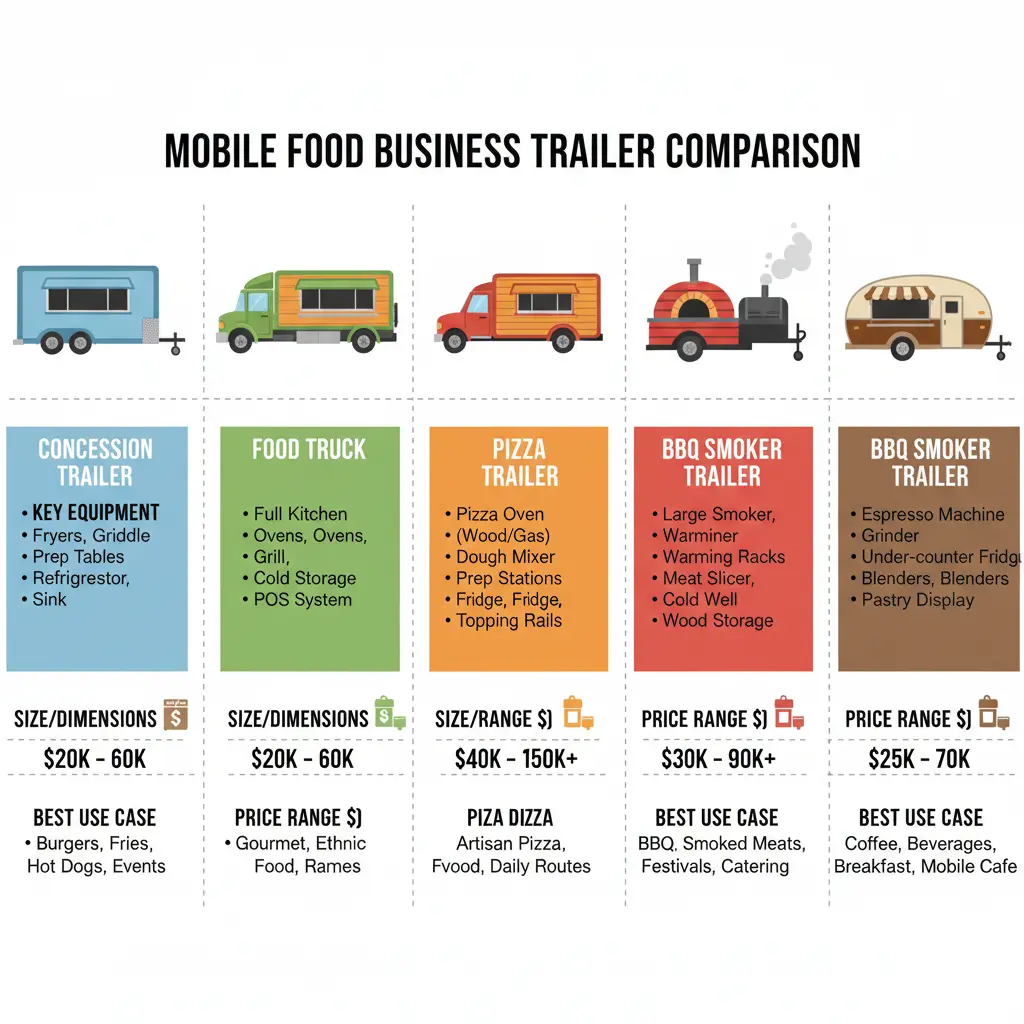
Concession Trailers Most Versatile & Popular
Concession trailers are the bread-and-butter of mobile food (and the most common used options available). They’re standalone kitchens towed to events, festivals, fairs, carnivals, and fixed locations.
Size spectrum: 6’x12′ up to 8.5’x28′. Most functional trailers hit 16-24 feet.
Equipment range: Bare-bones (counter, sink, minimal storage) to fully loaded (fryer, griddle, multiple refrigeration units, 3-compartment washing station, fire suppression system).
Price range: $13,800 for entry-level models to $77,000 for premium, full-kitchen builds.
Operational sweet spot: Concession trailers excel at:
- Festival and event catering (setup in morning, teardown by evening)
- Fixed farmers market locations (same spot multiple days weekly)
- Large venue operations with dedicated parking (fairgrounds, corporate events)
- Specialized menus where equipment doesn’t get moved frequently
The compromise: You need a separate vehicle to tow it. Logistics matter. Maneuvering a 24-foot trailer through downtown streets to access narrow event parking is painful. Some cities restrict trailer dimensions or require special permits for trailers over 20 feet.
Food Trucks vs. Food Trailers Know the Critical Difference
This distinction determines your mobility, costs, and operational flexibility:
| Factor | Food Truck (Self-Powered) | Food Trailer (Towed) | |
|---|---|---|---|
| Initial Cost | $50,000–$175,000 used | $8,000–$77,000 used | |
| Vehicle Required | Built-in engine/transmission | Separate tow vehicle | |
| Fuel Costs | Higher (truck engine + chassis) | Lower (tow vehicle only) | |
| Mobility | Move to any street/location instantly | Requires parking where towing is legal | |
| Setup Time | 15-30 minutes | 45-90 minutes (hook, setup, utilities) | |
| Maintenance Costs | Higher (engine, transmission, brakes) | Shared with tow vehicle | |
| Best For | High-traffic street vending, rapid relocation | Fixed locations, large events, farming ops | |
| Space Capacity | Limited kitchen footprint | Spacious (larger menus) | |
| Downtime Risk | Engine failure = business stops | Tow vehicle failure = business continues |
The decision framework: Choose a food truck if you’re mobile-first (chasing lunch crowds downtown, hitting multiple neighborhoods per day). Choose a trailer if you operate from 1-3 fixed locations (farmers market booth, festival circuit, corporate catering hub).
The cost difference is brutal $60K more upfront for a truck that breaks down more often, costs more to fix, and takes longer to set up.
Specialty Trailers Pizza, Barbecue, Coffee, Ice Cream
Specialized trailers come pre-engineered for a single cuisine concept. Think wood-fired pizza ovens, commercial smokers, espresso systems, soft-serve ice cream lines.
Why they command premiums: The equipment integration is sophisticated. A brick oven isn’t bolted on as an afterthought—it’s engineered into the trailer’s weight distribution, electrical system, and ventilation. Specialized trailers require trained operation and maintenance specific to that equipment.
Price premium reality: Specialty trailers cost $5K-$20K more than generic concession trailers of identical size. A 20-foot “empty” concession trailer runs $20K used. That same trailer pre-outfitted as a pizza operation? $45K-$65K.
The profitability flip side: Specialization = reduced competition and higher margins. A pizza trailer at a farmer’s market occupies one booth. Pizza is defensible (you’re not competing with 12 taco stands). Margins on specialty items run 50-65% versus 25-35% for generic burgers-and-hot-dogs.
Risk calibration: You’re betting the market wants your specialty. If pizza underperforms in your region, you’re stuck with equipment that doesn’t transfer to other concepts. Generic trailers stay liquid in the used market indefinitely.
Empty / DIY Concession Trailers For the Budget-Conscious Builder
Some buyers skip the used equipment entirely and purchase bare trailers ($8,970–$22,400), installing their own equipment on their timeline and budget.
The advantages:
- You choose every piece of equipment (upgrade-first mentality)
- You build workflow exactly how you want it
- You spread equipment costs over months instead of buying the previous owner’s solved problems
- You avoid inheriting hidden maintenance issues (bad compressor, leaky propane lines, etc.)
The harsh reality:
- You need technical knowledge (or expensive contractors) to pass health code inspection
- Electrical and plumbing mistakes can cost $1K-$3K to fix
- You need commissary access during build-out (not all cities allow this)
- Timeline stretches from 3 months to 9-12 months
- You face regulatory rejection if your layout doesn’t meet health department specifications
This path works if you’re genuinely handy, patient with logistics, and have capital reserves for contractor help. It’s a catastrophe if you underestimate the complexity and run out of cash mid-build.
How to Safely Buy a Used Food Trailer The Inspection Checklist
This section separates buyers who sleep at night from those waking up in cold sweat realizing they paid $22K for a trailer with a rusted-through frame.
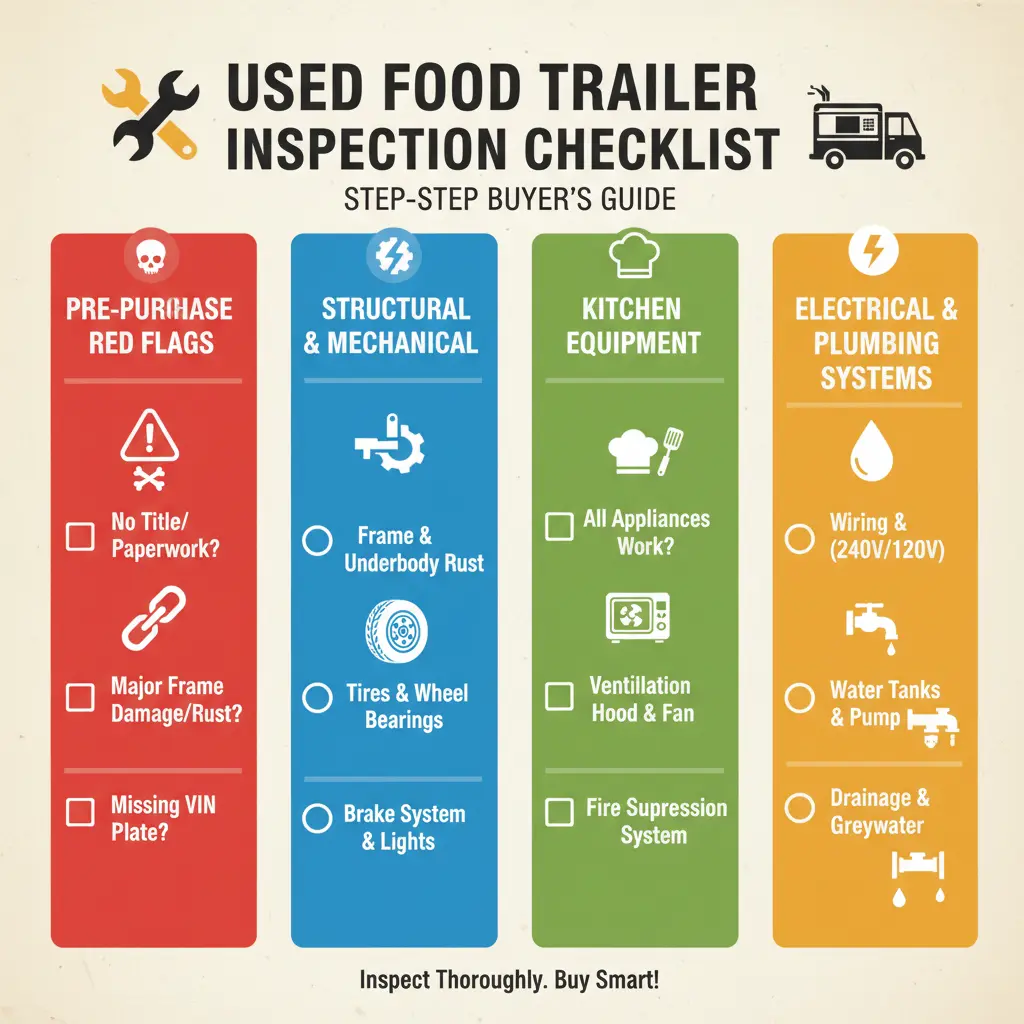
Pre-Purchase Red Flags That Scream “Walk Away”
Never, ever proceed if you encounter these:
Seller refuses in-person inspection: This is automatic disqualification. Period. If they’re unwilling to let you physically examine the trailer, they’re hiding catastrophic defects.
Missing maintenance records: You have no history of oil changes, propane system certification, electrical testing, or previous repairs. You’re flying blind on what’s been broken and supposedly fixed.
Title doesn’t match seller’s name: This indicates either theft, lien complications, or ownership gaps that create legal liability. Running the VIN through the National Insurance Crime Bureau takes 5 minutes. Do it.
Seller rushing you for immediate decision: Legitimate sellers are patient. Scammers pressure. The phrase “I have three other buyers interested” is pressure. Counter with “Great, let’s get independent inspections scheduled.”
Structural rust in critical areas: Extensive rust on the frame (not cosmetic surface rust, but pitting and erosion), wheel wells, or around the coupling point indicates structural compromise. A rusted frame can’t reliably tow it’s a safety hazard.
Water damage evidence: Stained ceiling panels, soft/spongy flooring, musty odor, visible mold, discolored walls. Water damage spreads fast and expensive repair. $8K trailer with water damage = $15K in restoration costs you can’t recoup.
Non-functional electrical or plumbing: If the electrical panel is completely dead or plumbing produces no water pressure, you’re looking at $2K-$5K in system replacement. Not a deal-sweetener it’s a dealbreaker at lower price points.
Critical Inspection Points: Structural & Mechanical
Treat this like buying a used car, except the stakes are higher (you’re operating a business, not just transporting yourself).
Frame inspection: Check wheel wells for rust (this is the critical weak point where water collects). Look for stress fractures in welds, especially around the tongue and hitch connection. Run your hand along the undercarriage—rough corrosion means structural compromise. Check for evidence of previous accidents (misaligned frame, panels that don’t sit flush).
Flooring assessment: Walk the entire length of the trailer. Do you detect soft spots or bouncing? Soft spots indicate water damage in subfloor layers. Water stains on the floor indicate roof leaks or failed plumbing. Press your shoe hard on every corner if you sink slightly or hear creaking, structural deterioration is happening.
Roof and seals: Check all seams for separated caulking or deteriorated sealant. Look at corners and edges where the roof meets the walls (major leak entry points). Inspect around any vents, AC units, or roof-mounted equipment for separation. If the roof shows pitting or chalky deterioration, the protective coating is failing.
Tires and brakes: Check tread depth with a penny—tread should exceed 4/32 inch. Look for uneven wear (indicates misalignment). Check tire age—sidewalls show manufacture date in DOT code (anything over 8 years is replacement-recommended). Test brake responsiveness at low speed (brakes should be responsive, not spongy).
Electrical systems: Test all 110V outlets with a circuit tester (check for proper grounding, no reverse polarity). Verify GFCI protection on outlets near water sources. Check the main electrical panel all breakers labeled and proper sizing? Test that all lights, fans, and equipment power on.
Hitch and coupling: Verify the hitch weight rating exceeds the trailer’s loaded weight. Check the coupling mechanism for cracks, deformation, or corrosion. Confirm the safety chain setup and coupler pin condition.
Kitchen Equipment Assessment
Run the appliances: Don’t just look at them. Turn them on. A stove burner that looks fine visually might have inconsistent heat. A fryer pilot light might be failing. A refrigerator hums but doesn’t achieve proper temperature.
Stove: Light all burners, verify even heating across the cooking surface, check oven thermostat accuracy with an independent thermometer.
Fryer: Does it heat to proper temperature? Are recovery times reasonable? Check oil quality (clear vs. dark = well-maintained vs. neglected).
Refrigerator/Freezer: Does it maintain temperature? Listen for compressor cycling (should run every 10-15 minutes). Open/close the door does it seal?
Ventilation hood: Does it draw air properly? Are filters clogged? Check for grease buildup inside the ductwork.
Water and waste systems: Run hot and cold water through sinks flow rate and temperature both matter. Check water tank capacity (printed on the tank). Check waste tank capacity this directly impacts operational hours between empties. Verify the 3-compartment sink setup meets health code (typically 3 sinks plus a hand-washing sink).
Fire suppression system: Every cooking trailer requires a fire suppression system (usually wet chemical) if cooking is happening. Check inspection tags when was it last serviced? Verify nozzles are directed properly at the cooking surface. Check that the system is actually installed and not just a checkbox on the listing.
NSF certification reality: Look for NSF (National Sanitation Foundation) labels on food-contact surfaces. Commercial-grade equipment has this certification; residential equipment doesn’t. A trailer using residential appliances (IKEA cabinets, standard dishwashers) will be rejected during health inspection. Upgrade costs are $4K-$8K to bring non-compliant trailers up to standard.
Health & Compliance Check
Before you even negotiate, contact your local health department. No, seriously. Call them.
Ask specifically:
- What are the minimum requirements for a food trailer in our county?
- Does this trailer (describe equipment layout) meet those minimums?
- Are there any equipment requirements I’m missing?
- What’s the inspection process and timeline?
Documentation to obtain from the seller:
- Previous health inspection reports (if available)
- Proof of propane system certification (should be tagged annually)
- Proof of electrical inspection (if the trailer was ever permitted)
- Any modification records (equipment replacements, plumbing work, etc.)
Physical compliance requirements:
- 2-3 compartment sink with hot and cold water (separate from hand-washing sink)
- Hand-washing sink with foot-pedal (not a standard faucet handle—contamination risk)
- Proper drainage and grease trap connection
- Fire suppression system over cooking areas
- Thermometers on all refrigeration units
- Food storage properly segregated from cleaning supplies
- Pest-proof construction (no holes, gaps, or damage allowing entry)
Financing Your Used Food Trailer Purchase
$15K to $30K is beyond “cash in your pocket” for most entrepreneurs. Understanding financing options means the difference between launching or staying stuck in planning mode.
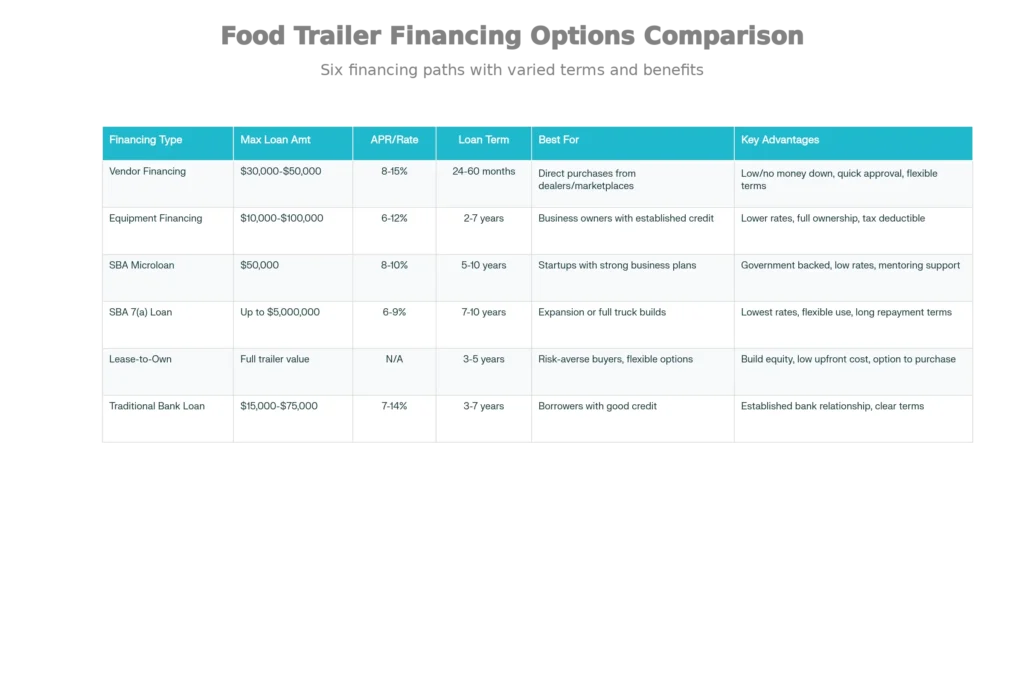
Vendor Financing Offered by Marketplaces & Direct Sellers
How it works: UsedVending.com and UsedFoodTrucks.com partner with equipment financing companies. Instead of paying full price upfront, you finance through them. Same-day approval is possible if your credit passes basic screening.
Terms and rates:
- Repayment: 24–60 months (most common: 36-48 months)
- APR: 8–15% depending on credit score and down payment
- Down payment: Often low or zero if you meet credit thresholds
- Speed: Approval to funding in 24-48 hours
When it makes sense: You found the perfect trailer on UsedVending.com, want it yesterday, and can’t wait for bank underwriting. Vendor financing is fast and requires minimal documentation.
When it’s expensive: Your credit score is under 700—you’ll be at the 13-15% APR ceiling. Over a 48-month term, that 1-2% difference adds $800-$1,200 to your total interest paid.
Equipment Financing From Banks & Specialized Lenders
How it works: You apply to a bank, credit union, or specialized equipment lender (like Crestmont Capital). They evaluate your credit, income, and the trailer’s value. If approved, you receive funds to purchase.
Terms and rates:
- Maximum loan: $10,000–$100,000 (depends on lender and your creditworthiness)
- APR: 6–12% for qualified borrowers
- Terms: 2–7 years repayment
- Speed: 5-10 business days (slower than vendor financing)
Advantage over vendor financing: Lower rates (8-10% is achievable with 700+ credit score). Full ownership. Interest paid may be tax-deductible as a business expense.
Best lenders for this:
- Credit unions (typically 1-2% cheaper than banks)
- SBA-partnered lenders
- Specialized equipment finance companies (Crestmont, Marlin, etc.)
SBA Loans (Small Business Administration)
The US government actually wants you to succeed in food entrepreneurship. SBA loans prove it.
SBA Microloan:
- Maximum: $50,000
- APR: 8–10% (significantly lower than commercial rates)
- Terms: 5-10 years
- Best for: Entry-level trailers, used equipment, startups with solid business plans
- Speed: 2-4 weeks
Why you care: A $35K microloan at 8.5% over 72 months = $577/month. Compare that to 12% vendor financing: $781/month. You save $204/month just by going SBA route.
SBA 7(a) Loan:
- Maximum: $5,000,000 (yes, really)
- APR: 6–9% (lowest available)
- Terms: 7-10 years
- Best for: Expansion, full truck builds, multiple locations
- Speed: 3-6 weeks
The application process: You’ll need a business plan. Not a novel—two pages showing what you’re selling, target market, why you’ll succeed, and how trailer purchase fits into year-one revenue projections.
SBA lenders actually want to fund food entrepreneurs. They have higher approval rates than banks because they’re backed by the government.
Lease-to-Own Programs
Some manufacturers and specialized lenders offer lease-to-own structures where you build equity monthly instead of financing debt.
How it works:
- You sign a 3-5 year lease agreement
- Monthly payments ($300-$800 depending on trailer value)
- Percentage of each payment builds equity (typical: 60% equity, 40% lease cost)
- At end of lease, you own the trailer outright (or purchase the remaining equity)
When it makes sense:
- You want to test-drive ownership before committing
- You want lower initial payments (equity buildup feels better than interest paid)
- You value the psychological win of “building ownership”
When it’s expensive: Over 5 years, you pay significantly more total dollars than buying outright. A $25K trailer financed at 9% costs $8.5K in interest. Lease-to-own structures often cost $12K-$16K total over 60 months because the lessor builds profit into the “equity buildup” percentage.
Rent-to-Own vs. Buy Pros & Cons
Rent-to-Own Advantage: Lower monthly cash flow demand. Roaming Hunger’s model includes marketing support (website, social media, catering referrals worth $2,000-$1,000 monthly). Total program value reaches $90K over the lease term.
Rent-to-Own Disadvantage: You pay more total dollars. Flexibility to exit is limited (breach of lease = financial penalty). You’re speculating on success before full commitment.
Buy Advantage: Full ownership immediately. You build equity 100% of payment (not 60%). You can sell whenever you want without penalty. You own the residual value.
Buy Disadvantage: Higher monthly payments. Higher total debt service. Risk if the business fails in year two.
Decision framework: Buy if you have capital and confidence. Lease-to-own if you’re testing a concept and value low-payment flexibility more than ownership speed.
Where to Avoid & Red Flags Protect Yourself
International Sellers & Cheap Import Sites
Alibaba, Made-in-China, and similar international marketplaces are tempting. A concession trailer that costs $25K domestically sells for $8K-$12K from Chinese manufacturers.
Why it seems smart: 60% cost savings is seductive.
Why it’s a disaster:
Quality inconsistency: Food trailers from factories with zero US regulatory knowledge often violate FDA, EPA, and local health codes. Electrical systems use different standards. Plumbing doesn’t meet US codes. These aren’t minor issues—they’re rejections at the health inspection.
Shipping delays: 8-14 weeks for production. 4-6 weeks for ocean freight. 2-3 weeks for customs/import inspection. You’re looking at 4-5 month delivery. Meanwhile, competition launches.
Damaged arrival: Overseas shipping means salt water, rough handling, temperature extremes. Trailers arrive with rust, dents, corroded wiring, cracked tanks. Damage claims are nightmares from 6,000 miles away.
Recourse is zero: If the trailer arrives with a failed refrigerator, a propane system that doesn’t function, or electrical grounding issues, you can’t return it. You’re stuck fixing it in the US at contractor rates ($2K-$5K per system replacement).
Real math: A $10K imported trailer that arrives with $5K in damage and $3K in modification costs to meet US health codes costs you $18K total. You bought the “deal” and ended up paying the same price with four months lost.
Common Scams in the Used Food Trailer Market
These happen constantly. Here’s how to avoid them:
Fake titles and ownership disputes: Seller provides title but isn’t the registered owner (title is “assigned” from previous owner, but the chain is unclear). You purchase, transfer into your name, then find a lien is still attached. Previous owner sues, claiming unpaid loan. You’re stuck with a trailer you can’t legally operate.
Prevention: Get the title certified by your local DMV before handing over money. It costs $25-$50 and proves everything is clean.
“As-is” sales hiding major mechanical failures: Equipment works at time of viewing but breaks in week two. Seller claims “as-is means as-is” and refuses any responsibility. You’re paying for repairs the previous owner knew existed.
Prevention: Get everything in writing. Specific condition of appliances, electrical, plumbing should be listed. Any “as-is” clause should explicitly exclude hidden defects (fraud is different from caveat emptor).
Photos from different units: The main photo is pristine. The trailer you inspect is trashed. Seller claims “those were older photos” or “we’re remodeling it.”
Prevention: Demand the seller send you photos of the exact VIN’s unit with yesterday’s date and a newspaper in the photo. Video walkthrough is better.
Unsecured financing with hidden fees: “Financing approved!” comes with $800 in “documentation fees.” Annual maintenance charges appear in fine print. GPS tracking fees (yes, this happens).
Prevention: Get the full financing agreement in writing before committing. No fees should be surprises.
Buyer’s remorse clauses that don’t exist: Marketplace sales are final. You buy it, you own it. No returns. If you miscalculated your timeline, overestimated your capital, or the trailer doesn’t fit your operational needs, tough luck.
Prevention: This isn’t a scam per se it’s how used equipment sales work. Don’t buy expecting 30-day returns. Be certain before handing over money.
Private Sellers vs. Dealers Which Is Safer?
| Factor | Private Seller | Established Dealer |
|---|---|---|
| Price | 15-30% cheaper (no markup) | 10-20% premium (business costs) |
| Warranty | None (as-is purchase) | 30-90 day mechanical warranty common |
| Motivation | Cash sale (may rush or exaggerate condition) | Reputation-dependent (accurate descriptions) |
| Inspection | You’re entirely responsible for vetting | Dealer often provides documentation |
| Recourse | Essentially none (caveat emptor) | Legal avenues if misrepresented |
| Documentation | Often incomplete or missing | Usually complete maintenance records |
| Financing | Private loans only | Often integrated with lenders |
The takeaway: Use marketplace platforms (UsedFoodTrucks.com, Mobile Food Alliance, eBay) that split the difference. They’re not private sellers (less accountability), but not formal dealerships either. They’re monitored for fraud and offer some buyer protection without charging full dealer markups.
Private sellers work if you’re mechanically confident and willing to walk away easily. Dealers work if you want sleep-at-night protection.
Advanced Tips Pro Buyer Strategies
Timing the Market When Prices Drop
Food trailer seasonality is real and predictable.
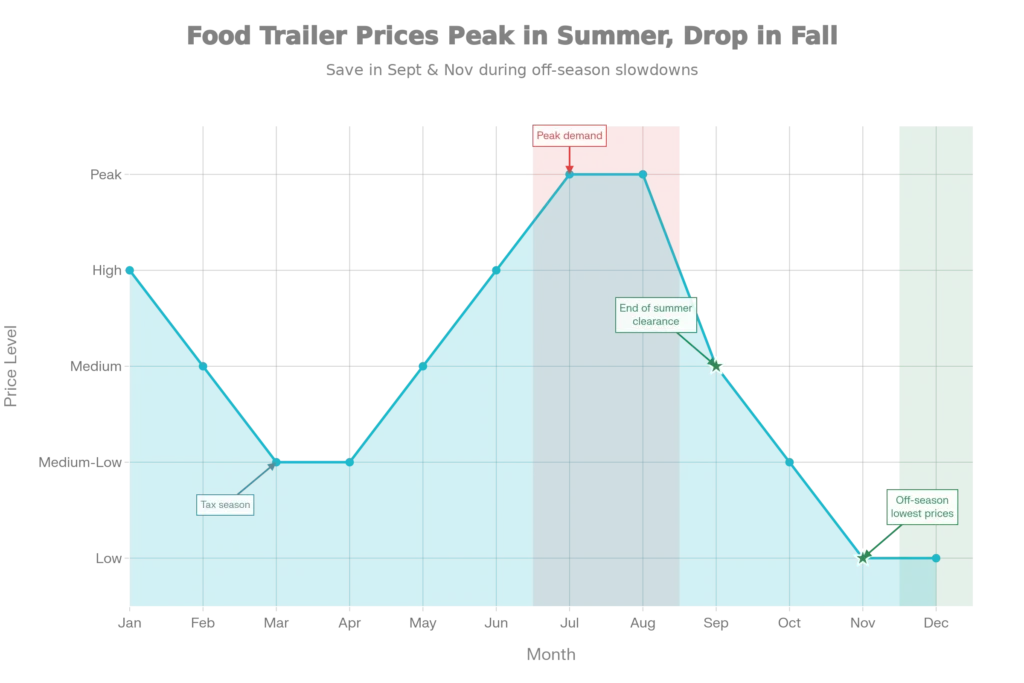
September: Vendor Clearance Season (BEST TIME) Summer ends, events wind down, owners downsize. Competitors aren’t yet looking (most shopping starts January). Prices drop 15-25% from summer peaks. Selection is still solid (September sales haven’t depleted inventory).
November-December: Off-Season (BEST TIME) Holiday operations are thin, many vendors shut down. Tax-year desperation drives sellers. Prices hit annual lows (20-35% below summer). Selection shrinks (lower inventory), but deals are outstanding.
March-April: Tax Season Squeeze Entrepreneurs facing capital gains taxes or unfavorable business returns liquidate. Prices drop 15-20% as desperate sales appear. Less selection than fall but better than winter.
January-February: The Trap New Year resolution buyers flood the market. Demand spikes, selection is high, but prices rebound 5-15% from lows. Competition is intense (you’re negotiating against other eager buyers). Wait till January and you lose the 30% discount advantage.
May-August: Peak Pricing Summer season operations are thriving, no one’s selling. Festival and event season is here, demand peaks. Prices are 15-25% above average. Inventory is lowest.
Action item: If you don’t need the trailer urgently, wait till September or November. If you need it now (June-August), expect to pay premium pricing and accept limited selection.
Negotiation Tactics
Get professional inspections: Before negotiating, commission a professional mechanical inspection ($150-$300). This isn’t optional it’s your leverage.
Use findings as leverage: A professional inspection report identifying $3K in needed repairs gives you negotiation firepower. “Your asking price is $18K, but the inspection identifies $3K in repairs. I’m offering $15K to cover that delta.”
Offer full payment for discount: Sellers prefer certainty over financing logistics. “I’ll pay full cash today for $2,000 off the asking price.” This works because cash moves ownership immediately (no financing risk, no title delays).
Bundle equipment purchases: If you’re buying a trailer and need additional equipment (replacement fryer, extra prep table, portable generator), negotiate a package price. Sellers often drop bundled prices 10-15% to move everything at once.
Walk away credibly: The strongest negotiating position is genuine willingness to leave. If you’ve seen 5 trailers and you’re okay with any of them, the seller senses this. Your offer stands or you move to the next option. Most sellers counter at 80-90% of asking price within two negotiating rounds.
Example: Asking price $22K. Your inspection finds $2,500 in needed work. You offer $18.5K. Seller counters $20.5K. You agree on $19.5K. Both parties feel they won something.
What’s Included vs. What Costs Extra
Smart buyers budget for the hidden costs buried in ownership transition.
Delivery and towing fees:
- Professional towing: $500–$2,000+ depending on distance
- Local pickup with your own vehicle: $0 (save this cost if possible)
- Delivery into a restaurant or event space: $200-$500 extra
Title transfer and registration:
- Title transfer: $100–$300 (county-dependent)
- New registration/plates: $75-$200 annually
- Out-of-state registration: Sometimes requires new inspection ($100-$200)
Health permits and licenses:
- Food handler’s permit: $50-$100 (per person, usually)
- Health department inspection: $100-$300 (sometimes waived if trailer already permitted)
- Local business license: $100-$500 (varies wildly by jurisdiction)
- Commissary access fee: $50-$150 monthly (required in some states)
Equipment warranty extensions:
- Extended warranty on appliances (3-5 years): $500-$1,500
- Fire suppression annual service: $150-$300 yearly
- Propane system annual inspection: $50-$100
Budget reality: Plan $2,000-$4,000 in post-purchase costs beyond the trailer price. A “good deal” at $18K becomes $21K-$22K once everything’s registered and operational.
Building Your Checklist Document Everything
Create a scoring system for potential buys so you’re not comparing apples to emotional excitement.
Sample scorecard (use 1-5 scale):
- Structural integrity (frame, rust, water damage): ___/5
- Equipment functionality (all appliances tested): ___/5
- Electrical system (outlets, grounding, panel): ___/5
- Plumbing and tanks (flow, capacity, leaks): ___/5
- Cosmetic condition: ___/5
- Compliance with local health codes: ___/5
- Documentation (maintenance records, title, permits): ___/5
- Seller responsiveness and transparency: ___/5
Total: ___/40
Score 35+: Strong buy candidate. Score 28-34: Negotiate aggressively or keep looking. Score below 28: Walk away.
Document everything:
- Save all communications with sellers (emails, texts, messages)
- Photograph the exact unit from multiple angles
- Video walkthrough with timestamp
- Inspection report from professional (attach to file)
- Sales agreement and bill of sale
- Title and registration documentation
This documentation protects you if issues arise post-purchase and provides evidence for warranty claims.
Conclusion & Next Steps Start Your Search
You now understand where the deals are, how to evaluate them, what separates legitimate buys from disasters, and how to finance without overpaying.
Here’s your action plan:
Step 1: Define Your Requirements What’s your budget? $10K-$15K? $20K-$30K? What type of food? Fixed location or mobile? Do you need a specific equipment setup?
Step 2: Contact Your Local Health Department Call them directly. Ask what a food trailer needs to operate in your jurisdiction. Get the requirements in writing. This prevents months of wasted time modifying a trailer that never passes inspection.
Step 3: Create Your Inspection Checklist Print the checklist from this guide. Bring it to every viewing. Don’t rely on memory.
Step 4: Start Browsing (Target Your Platforms by Budget)
- Under $8K: Craigslist, Facebook Marketplace
- $8K-$20K: Facebook Marketplace, UsedFoodTrucks.com, eBay
- $20K+: UsedFoodTrucks.com, Mobile Food Alliance, Direct Dealers
Step 5: Schedule 5-10 In-Person Inspections Don’t buy the first trailer you find. Inspect multiple units. This teaches you what “good condition” actually looks like versus what sellers claim.
Step 6: Negotiate and Finance Use inspection findings as leverage. Explore SBA loans if credit allows. Don’t overpay for speed.
Step 7: Transfer Title and Get Permitted Handle title transfer before operation. Get health permits in order. This is non-negotiable.
Free Resources & Tools
Health Department Templates: Contact your state health department’s website for food trailer inspection guidelines and equipment checklists specific to your region.
Inspection Guides: Quality Food Trailers publishes detailed inspection guides covering structural integrity, electrical systems, and equipment evaluation.
Financing Calculators: SCORE.org offers free business loan calculators for SBA loans and equipment financing. Input loan amount, rate, and term to see monthly payments instantly.
Professional Inspection Networks: Search “certified food equipment inspector” + your city. Commercial kitchen inspectors cost $150-$300 but save thousands in hidden defect discovery.
Local Small Business Associations: SCORE chapters near you often mentor food entrepreneurs on equipment purchasing and business planning.
Your Move—Take Action Today
Ready to find your next food trailer? The nation’s largest marketplace has 5,741+ active listings from verified sellers. Browse by price, location, equipment type, and condition. Apply for pre-approved financing to understand what you can actually afford. Connect with sellers and schedule inspections.
Your mobile food business doesn’t launch with perfect timing or flawless execution. It launches when you stop planning and start inspecting trailers with a professional eye.
Which price range matches your budget? Start there. Which platform aligns with your timeline? Begin your search. The next 30 days will teach you more about the market than reading 50 articles.
The perfect trailer isn’t waiting to be discovered it’s waiting to be negotiated down by someone who did the homework.
Now it’s your turn: Which tactic from this guide will you implement first? Will you contact your health department this week, or schedule your first in-person inspection? Share your timeline in the comments—let’s get you operating.